


Rebar is one of the most widely used metal materials in the construction industry. This product, which is also called steel reinforced concrete structure, is used to strengthen the building against any accident. In addition, there are different types of rebar available in the market, each of which has its own characteristics and is used for different purposes. The classification of this product is based on the degree of malleability, appearance and even on the basis of resistance. Stay with us to explain more about this product.
?What is rebar
Rebar is considered a type of solid profile, which has a small width and a long length. This type of steel is used for the construction industry. Concrete has low tensile strength and in order to solve this problem, rebar is also used in it. Before the concrete is poured, the rebars together with the wire form a reinforced concrete structure. Then, each reinforced concrete structure is placed in the building and its interior is filled with concrete. Finally, with the drying of the reinforced concrete structure, the rebars increase the tensile strength of the concrete.
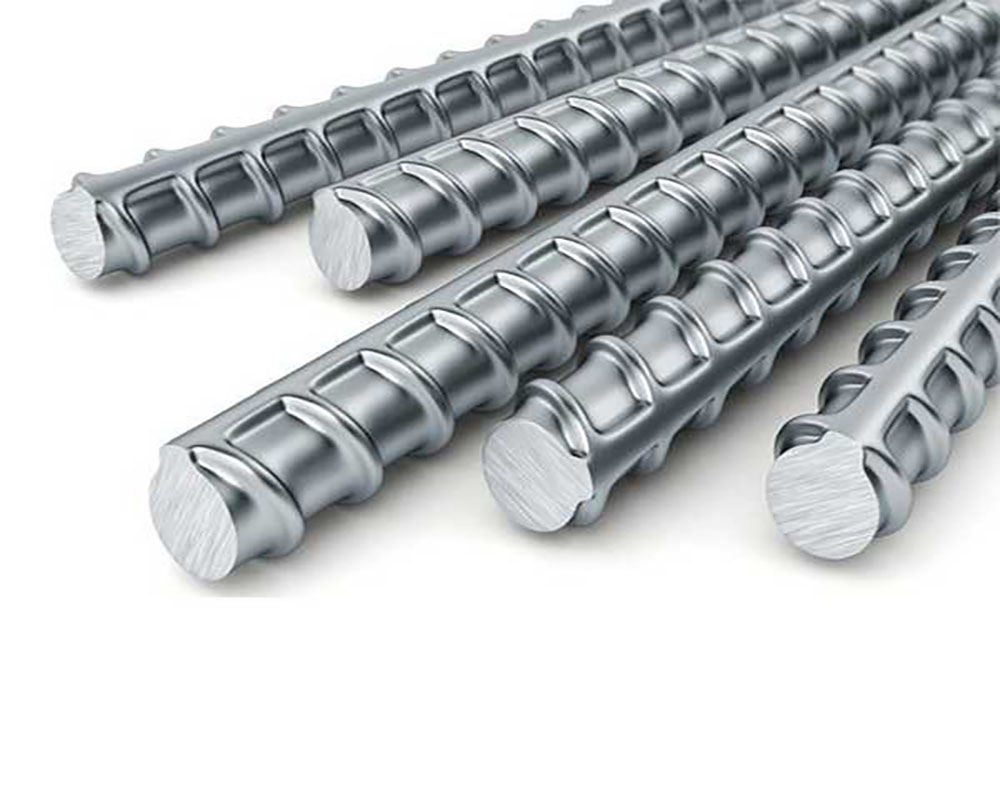
Rebar, like iron beams and other profiles, has different types, including simple and ribbed products. Each of these types of rebars are used to connect concrete better. The most important reason for using rebar in construction is to prevent concrete from breaking and cracking. At the same time, the resistance of the building is multiplied.
?What is the use of rebar
Concrete is one of the most resistant materials used for buildings. so that it is difficult to crush and destroy it. But concrete alone does not have this volume of resistance and is fragile due to lack of tensile strength. Therefore, rebar is also used in concrete structures to ensure the tensile and torsional strength of concrete.
In general, the use of rebar types can be categorized as follows:
For primary strengthening of the building
This product is used to increase the resistance of buildings against designed loads (in multi-story buildings).
Secondary reinforcement of the building
In order to reduce cracking and stresses caused by temperature changes and natural events (earthquake), the local resistance of the building should be increased. This work is done with the help of concrete and rebar.
Building reinforced buildings
There are holes inside the concrete material that will collapse very soon if the rebar is not placed in it. The use of this steel product causes tensile loading of concrete columns. This composition is completed with the help of mortar and grout.
All types of rebars available in the market
Rebar profiles have different types, including the following:
Trans rebar
It is one of the most widely used types of steel rebar, which has various dimensions and shapes. Also, this product is produced with different dimensions and sizes. During the production of this type of rebar, its surface is polished.
Rebar Khamut
Another type of reinforcement available in the market is used to increase the resistance of shear forces of concrete columns. Also, these products prevent the spread of cracks in the column. Khamut rebar is also used to prevent protrusion of the longitudinal reinforced concrete structure.
straight rebar
If you want to increase the tensile strength of concrete, you should go for straight rebar. This product prevents injury and damage to the building by increasing the tensile strength and flexibility of concrete columns.
Rebar
They use this product in order to establish a complete connection between the chamout and longitudinal rebar. Also, if you want to increase the shear resistance of the dampers, you need a pin bar.
Vaulted rebar
It is another type of rebar available in the market, which is used in concreting the foundation and floor. This product should be placed in two consecutive horizontal grids with a certain distance inside the mold.
stirrup bar
It is another rebar profile that is often placed between two tables of reinforced concrete structures. This concrete structure product holds vertical or longitudinal reinforcements in the concreting of slabs and walls.
Edca rebar
If you want to increase the resistance and tolerance of negative anchors in beam supports, you need Edka type rebar. This product also increases the tolerance of shear forces.
Technical characteristics of rebar types
There are two types of rebar products in the market, simple and ribbed. There are many companies in Iran that are active in the production of this product. This product is classified into different groups based on a (Russian) standard, which includes A1, A2, A3 and A4.
Companies introduce various products in the market, each of which has unique dimensions, sizes and looks. But their diameter and length are almost the same. In this way, the diameter of most of the rebars in the market is between 6 and 60 mm and their length is 12 meters. If the diameter of the rebar is less than 10 mm, it is supplied in coil form.
If we are to name the features and technical specifications of this product, it includes the following:
Having a coefficient of thermal expansion
When we talk about the coefficient of thermal expansion, it means that the volume, length and area of a product must change with temperature change. This flexibility prevents breakage and cracking. Since the coefficient of thermal expansion in steel and concrete is very similar, additional deformation and stress are not created in reinforced concrete structures. In other words, their shape does not change due to expansion and contraction. Buildings that are in environments with continuous temperature changes have higher resistance with these materials.
Having elasticity
Elasticity is the ability of an object to return to its original state. One of the most important technical and mechanical characteristics of rebars is having this property, which is estimated at around 200 GPa. Of course, it is different for rebars with different dimensions and sizes. But if the elasticity value is less than 200 MPa, you need to use more rebar to increase its elasticity. Otherwise, concrete columns will crack very soon.
Steel bars retain their elasticity before reaching yield strength. Therefore, if less load is applied to them from the yield point, as soon as the load is removed, the reinforced concrete structure will return to its original state. Of course, provided that the yield strength of the rebar is between 275 and 690 MPa. This value is true in all rebars of any size and dimension.

Lack of corrosion resistance
Another technical characteristic of rebars available in the market is that they are not resistant to oxidation. This steel product rusts very quickly in the vicinity of oxygen and moisture. But when it is placed inside the concrete, its pH rises above 12. As a result, like a cover for the rebar, it prevents it from rusting and rotting.
Acid jacking is a problem that occurs if there is a gap between the concrete and the rebar. In this way, the concrete does not completely cover the rebar. After some time, the rebar rusts and expands. Occupying more space also causes pressure on the concrete, which will result in cracking of the concrete column.
Maintaining the strength of rebars
Another feature of a rebar for construction is to withstand high temperatures before changing their resistance and ductility properties. Therefore, if the reinforced concrete structure is damaged for any reason (fire) and leads to the deformation of the steel rebar, you can still use the rebar to rebuild the structure.
rebar isotropy
If the properties of the material are the same in different directions, it is called isotropy. Steel bars have the same property. Therefore, the shear strength of those walls is equal along their length.
Rebar fatigue rate
Fatigue means that the material’s resistance to cyclic loads is reduced. The amount of this fatigue is done by performing the test on the steel product. Although many engineers have emphasized that rebar fatigue does not have much effect on the instability of reinforced concrete structures.
What is the role of rebar in concrete?
Just like beams and gutters, rebars are used in concrete for several reasons, which include:
Increasing the strength of the reinforced concrete structure
One purpose of using rebar is to strengthen concrete. This steel product, which has different grades and grades and is produced in a simple and ribbed form, greatly reduces the possibility of concrete breaking. Ribbed rebars allow their ribs to be more firmly embedded in the concrete and increase the strength of this structure. For this reason, the role of rebar in reinforced concrete structures is vital.
Although concrete is a very strong and strong composite material, if pressure is applied to it from the center, it is easily stressed and cracks. For example, imagine a concrete beam in a concrete frame that is supported on two sides by several columns. Now there is no column in the middle of this concrete beam. If pressure is applied to the middle part of this concrete beam for any reason, it will split in half. To prevent this from happening, he places ribbed bars in the middle of the concrete beam to strengthen it. Now, whatever pressure is applied to the beam, nothing happens. Because the rebar absorbs and neutralizes the pressure.
Reduce concrete thickness
When the rebar increases the strength and strength of the concrete structure, there is no reason to increase its thickness. When the concrete structure becomes elastic with the help of rebar and resists cracking and breaking, there is no need to make it thicker. At the same time, it is easier for you to install a thinner concrete structure. Saving costs is one of the advantages of reducing the thickness of concrete, which is done with the help of rebar.
Types of rebar in terms of shape and appearance
Rebars available in the market are classified into different types based on their strength, dimensions and appearance. If we are to categorize them in terms of shape, there are three types of simple, ribbed and coiled (complex brick) available in the market. Each of these products has specific specifications and features that make their use different from each other. For example, the simple type is not suitable for pouring concrete.
In general, the characteristics of each type of rebar are:
Simple rebars
These types of steel rebars are in the form of smooth and uniform bars that do not have any protrusions on them. They are made in sizes from 6 to 50 mm and are used for construction industries. For example, for streets and airports, flat rebars are used to make contraction joints.
The contraction joint is used to prevent cracking and shrinking of concrete. Simple rebars are placed at certain distances between concretes to prevent them from cracking. These products are highly flexible and can be easily cut without being damaged. These products are not suitable for building and building bridges. Because they cannot increase the strength of concrete. Due to the lack of a tread, if pressure is applied to the concrete, it will soon separate from it. Therefore, the concrete structure breaks.
Ribbed bars
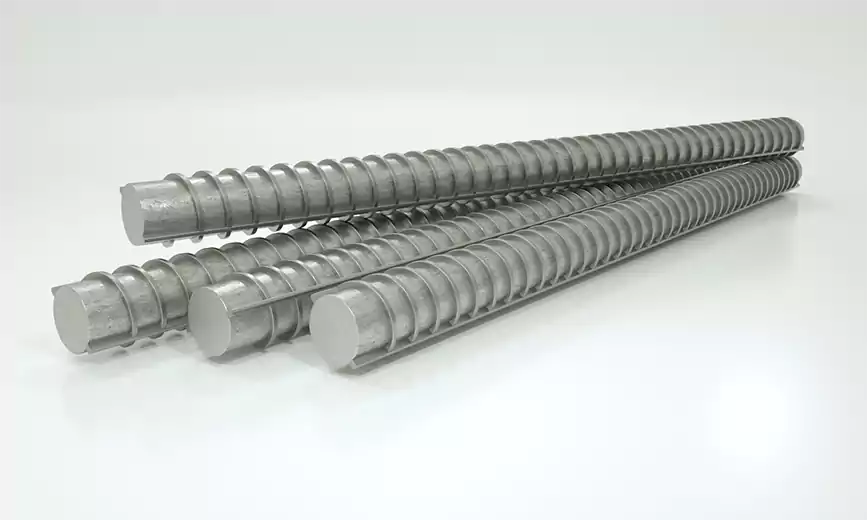
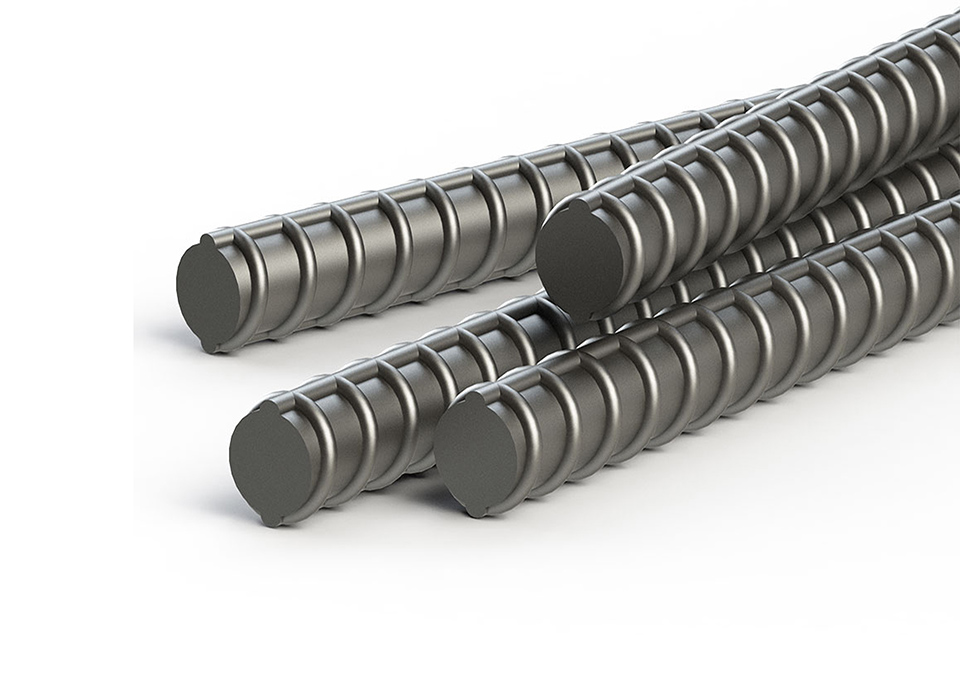
As we said, another type of rebar available in the market has treads. The surface of these products is rough and they are made with a thickness of 6 to 50 mm. Since the surface of these products is treaded, when used for concrete structures, their tread sinks into the concrete. As the concrete dries and hardens, it is not possible to separate the two.
Ribbed bars have two different types, which are:
TMT thermomechanical ribbed bars
These products are produced using high heat and have a very high resistance. If you want your concrete structure to have high strength, you should use this type of ribbed rebar for it. Ajda thermomechanical rebars have high flexibility and bending. Therefore, they can be suitable for earthquake-prone areas. They are also recommended for bridge construction. On the other hand, its weldability is also higher than other rebars. Among other characteristics of TMT rebars, we should mention their resistance to high temperature and oxidation.
HSD high resistance ribbed bars
Another type of ribbed rebar is HSD type, whose tread is complex and spiral. This type of rebar is the most suitable product for concreting, which is produced with a thickness of 4 to 50 mm. The low carbon level in HSD rebars makes them flexible and weldable. Therefore, if you want to go for high bending rebar for concrete structures, we recommend this product.
You can use these products to build industrial, commercial and bridge buildings.
Types of rebar in terms of resistance
If we are to categorize rebars in terms of strength and resistance, we will come across 6 different types of products. Galvanized rebars, fiberglass lamer, stainless steel, carbon steel, European and epoxy coated are the types of these products. In the following, the features of each of these products are briefly explained.
Galvanized rebars
These products are very resistant to rust. The galvanized coating used for them has increased their resistance to moisture. These products have a very high price and are recommended for areas with humid climates.
Limer fiberglass rebars
Reinforced fiberglass polymer (GFRP) is a type of composite similar to carbon fiber. This product has little flexibility and therefore you should not bend it. Among its other features, we can mention its light weight. At the same time, it is resistant to rust and you can use it to strengthen concrete structures.
Stainless steel bars
These products are the most expensive type of rebar in the market. For concrete reinforcement, stainless steel rebars are 1500 times stronger than black rebars. They are also suitable for preventing cracks in concrete due to their high flexibility.
Carbon steel rebar
Black bar or carbon steel rebars are widely used in the construction industry. These products do not have much resistance to moisture and oxidize very quickly. For this reason, they are suitable for dry areas.
European rebar
This product is produced using manganese alloy and is suitable for earthquake-prone areas. If you are going to have concrete structures with a one-piece structure, European rebar is the best product we recommend.
Epoxy rebars
This product is produced using carbon steel and coated with epoxy. Their resistance to rust is 70 to 1700 times that of carbon steel bars. These products are produced with elegance and have special uses.
Correct maintenance conditions for rebar
According to the features that we mentioned about the types of rebar, these products can be used according to their type, strength and appearance. Also, their storage conditions before use are very important. Otherwise, instead of increasing the strength of the concrete structure, it will not have any effect on it.
These products are not rustproof and easily absorb moisture from the environment. If you keep them in a humid environment for a long time, their oxide and diameter will decrease. To avoid this problem, you should store the bars in a covered and dry environment. Avoid placing the rebar on wet soil.
Before using the rebar, it is better to clean it with wire brushes to clean it from oxide and pollution. In this case, the adhesion of the rebar to the concrete will be better.
Before pouring concrete, spray the rebars or the rebar structure (rebar) with cold water. With this, the temperature of the rebars decreases and they stick to the concrete faster.

Buy rebar
There are many factories in Iran that market various rebars, which include:
- Isfahan Iron Smelting Factory
- Kaveh Steel Industries
- Sirjan Steel Complex
- Khorasan Steel Complex
- Azerbaijan steel factory
- Bafaq steel complex
- Bonab Steel Factory
- Sarmad Abarkoh factory, Yazd
- Kerman Steel Industries
- South Steel Complex
- Anahita Gilan Steel Complex
To buy rebar, you can get any product according to your application.
How much is the price of rebar?
Rebar is one of the profiles that are available in kilos and bundles. The price of this product is based on the basic price of iron and steel. On the other hand, the amount of supply and demand is another factor affecting the price of rebar. The exchange rate does not affect the price of this product.

